
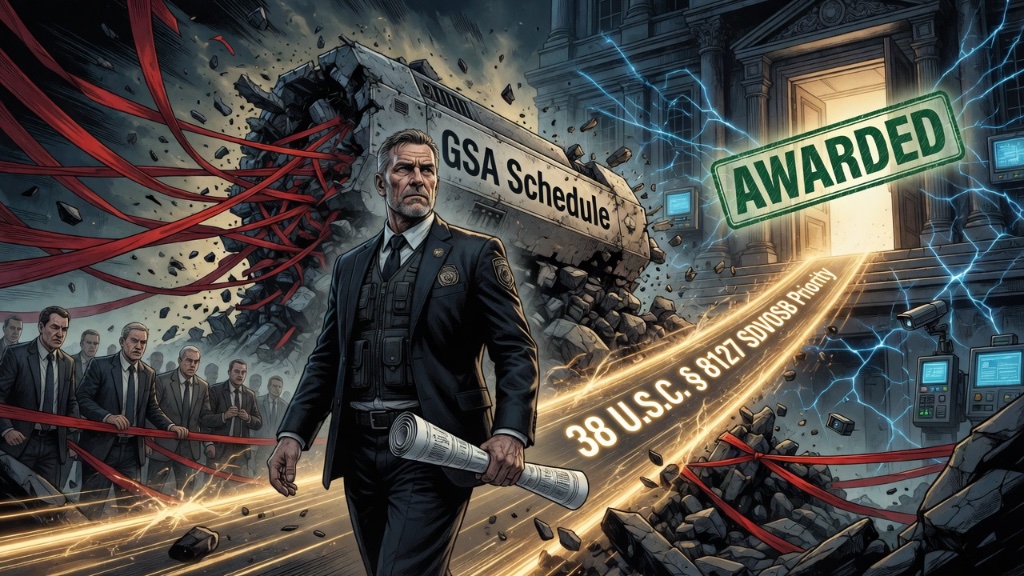
Hook Look: the GSA Schedule is comfortable. Predictable. Familiar.
Most vendors build their whole go‑to‑market around it. But comfort isn't a strategy for the VA. The law gives veterans priority. Not because it's polite. Because Congress put it in statute. That changes how you play. I'm Cory Franek. Service‑disabled vet. Security integrator.
We’re TSS Group LLC — CVE‑verified SDVOSB prime out of Scottsdale, AZ (UEI: VC8RJQ1TTGV5, CAGE: 8QS65).
We integrate physical security, Zero Trust, and persistent authentication for VA and DoD. I’ll tell you the problem. Then the solution. Short sentences. No fluff.
The GSA Habit
Most tech vendors default to the GSA Schedule for federal sales.
Makes sense on paper. Faster ordering. Established pricing. One contract to simplify life.
But the VA isn’t most agencies. VA has a statutory preference for veteran‑owned small businesses.
Look: when a contracting officer can place a set‑aside or make a direct award to an SDVOSB, they often must consider that route before turning to GSA orders. GSA can be a valid path. But if you lean on it exclusively, you lose first‑look.
And here’s the ugly truth: vendors follow the path of least resistance. That path often ignores statutory priority. So you’re shrinking your target without even trying.
(Seriously — if you only follow GSA, you’re handing away workable awards to teams that put an SDVOSB in the lead. Don't be that vendor.)
The SDVOSB Statutory Priority
Congress put the policy in law. 38 U.S.C. § 8127 requires the Department of Veterans Affairs to give preference to veteran‑owned small businesses and service‑disabled veteran‑owned small businesses in procurement. See 38 U.S.C. § 8127(a) and (d). Not guidance. A directive. SBA rules back up eligibility and ownership at 13 CFR § 125.15. The VA has its own ordering procedures in VAAR 819.7004. And when contracting officers look at simplified acquisitions or commercial‑item buys, FAR procedures (see FAR 13.201) matter — but they don’t erase the VA’s statutory duty to consider SDVOSBs first. Read that line again.
The statute gives VA officers a mandate. The regs and VAAR tell them how to do it. GSA Schedule orders live in the same universe, but they sit downstream of the VA’s statutory duties. (Here’s the friend version: VA contracting officers will pick an SDVOSB when the law, their procedures, and a clean team package line up. Make that easy.)
What This Means for Vendors
Plain talk: teaming with a CVE‑verified SDVOSB prime gives you a structural advantage at the VA.
Not a theory. Real advantage. Why? Because the VA has to consider SDVOSB firms first, in many buys. That means your tech gets a faster lane when it sits under an SDVOSB prime. Fewer bidders on set‑asides. Better odds on direct awards. Less procurement gymnastics.
Put yourself in the buyer’s shoes. They need a security solution. They have to document they considered the SDVOSB community. A CVE‑verified prime already clears that box. You come in as the partner who supplies the gear and the integration. Your product helps deliver mission outcomes instead of being a procurement headache.
Also: the VA trusts verified SDVOSB primes more quickly. The CVE badge speeds administrative reviews. Less back‑and‑forth. That matters when you’re proposing integrated systems — physical security tied to identity and persistent authentication — where technical integration and mission fit decide the award.
My opinion? Some vendors treat SDVOSB teaming like a checkbox. Bad move. Do the work. Lead with the SDVOSB prime. Own responsibility and delivery. That’s how you win.
The Vendor Playbook
Name the problem before the solution. Here’s what to do, now.
Get your house in order. If you sell through partners, vet their CVE status. If you don’t have a veteran partner yet, find one early. The quickest disqualifier is partnering with a firm that can’t pass CVE review. (See 13 CFR § 125.15 for eligibility rules.)
Team with a CVE‑verified SDVOSB prime. Not a label. A prime that leads integrations and owns delivery. VA evaluation looks at responsibility and past performance. We run integrations for a reason: we own the problem end‑to‑end.
Repackage your offer for VA mission outcomes. Don’t dump feature lists. Sell outcomes the VA cares about: secure patient data, protect facilities, reduce insider risk. Use SDVOSB teaming to tell a coherent story about delivery and compliance. Talk VA needs, not GSA line items.
Make it easy to award. Give pricing templates, compliance matrices, and a clear delivery timeline. If an acquisition official can quickly see that an SDVOSB prime meets the statute and the technical solution fits, they’ll pull the trigger.
CVE badge, clean teaming agreements, straightforward statements of work — they remove friction. Do these four steps and you beat most vendors who still treat the GSA Schedule like the only road. (And if you want the blunt truth from someone who’s walked the halls: the VA buys what’s easy to justify on paper and confident in delivery. Make your package both.)
Download the Full White Paper
Want the playbook with forms, sample teaming language, and acquisition references? We wrote the white paper: Why Teaming with a CVE‑Verified SDVOSB Prime Beats the GSA Schedule for VA Security Sales. It lays out the law, the regs, and the tactics — plus sample contract language that gets reviewed and awarded faster.
TSS Group LLC is a CVE‑verified SDVOSB prime (UEI: VC8RJQ1TTGV5, CAGE: 8QS65). We integrate physical security, Zero Trust, and persistent authentication for VA and DoD. If you sell technology into VA security — download the white paper. Read it. Then call us and let’s build the package that gets you awarded. Caveat: this post explains statutory priority and teaming strategy. It’s not legal advice. If you need a legal interpretation, get counsel.
But if you want practical, field‑tested tactics to win VA security work — start with the white paper and start teaming with a verified SDVOSB prime.
Citations:
38 U.S.C. § 8127(a)
38 U.S.C. § 8127(d)
13 CFR § 125.15
VAAR 819.7004
FAR 13.201.